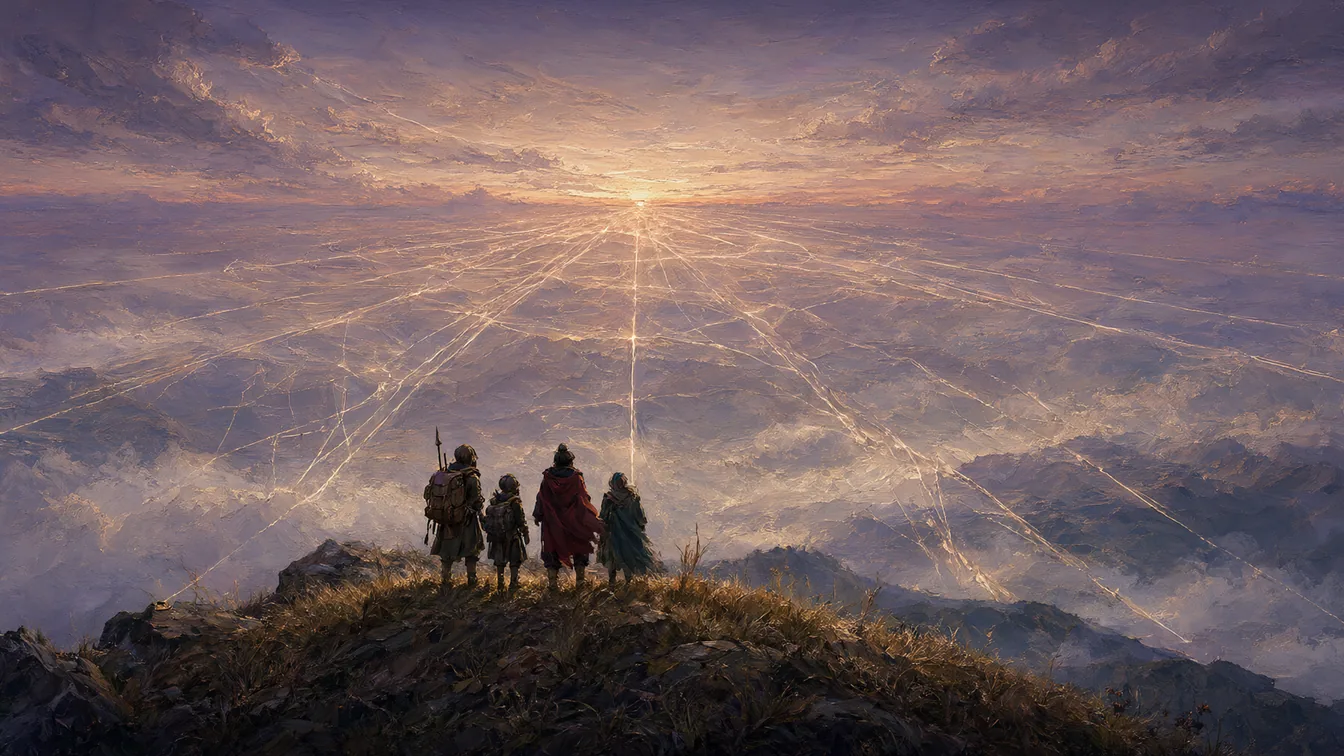
Ashes of the First World in a weekend: a whole JRPG campaign, and what it didn't skip
Game I's prologue, twelve chapters and epilogue went from a vertical slice to fully implemented over one weekend. Here's what that took, and what's still wrong.
I’m going to be careful with this one, because “a JRPG in a weekend” is the kind of line that falls apart when you look at it. So here is exactly what happened, with the dates from the commit log, and what didn’t.
What I started with
By the morning of Nov 7 I had decided what Ashes of the First World was: an original, story-driven fantasy JRPG, the first of a planned trilogy. I’d also made the call that mattered most. I ran a research pass comparing two ways of animating characters, a native 2D one and a 3D-rendered-back-to-2D one, and I picked native 2D, the way I’d already done GridBorne. That meant no 3D rigging for this game, so a lot of pipeline risk was gone before it started.
The repository’s first commit is Nov 7 at 7:31 pm. It already had the custom C++20/SDL3 engine and a vertical slice: a village, a field, roaming enemies and side-view Active Time Battle with one Elemental Resonance.
The timeline
All times are from the commit log.
- Nov 7, ~8 pm: the full Game I story manuscript, outline, character guide and script.
- Nov 7, 10:18 pm: the story director and cutscene runner, progression, respawning enemies, a shop, and the first two chapters’ data.
- Nov 8, 4:30 am: Chapters 1 to 4 staged, with art, maps and audio.
- Nov 8, 4:14 pm: Chapter 12 and the epilogue validated.
- Nov 8, 4:28 pm: all art for Chapters 9 to 12 delivered and wired in.
That’s the implemented campaign: a prologue, 12 chapters and an epilogue, playable from a new game to the end, in one weekend and 79 commits (and counting, because the fixes keep coming).
Why it was possible
Not because anything got faster in some magical way. Because the work was split across specialists and nothing waited on me to place a file:
- Claude Code wrote the engine, the story runner and the game data, and compiled the approved script into game events.
- AI-Node-2 generated the backdrops, portraits, enemies and story stills while code was being written.
- AI-Node-3 made the music, effects and voices.
- Local scripts cut, upscaled and rigged the generated art and packaged it.
- A campaign autopilot, a bot that plays the game from the start through to chapter ends, told Claude Code immediately when a change broke something. I used it constantly.
What “implemented” does not mean
Implemented isn’t finished. The autopilot only proves that a scripted player can get through. It doesn’t tell you whether the game is fun, readable or fair.
That’s why Codex (Luna, high reasoning) plays it independently. It doesn’t read the code. It plays through real inputs and writes down what it sees. Round 1 stopped almost immediately: after the prologue dialogue the screen went black and the game looked frozen. It wasn’t frozen, the title cards just took about ten seconds with no hint that you could skip them, but to a player that’s a blocker, and the bug report was right. Later rounds found a map that sometimes rendered black, a shop that bought an item on the last dialogue press, and a pair of slimes that re-engaged the party every time it tried to run.
Some of those are fixed and re-tested. Some aren’t, and the fights early in the game were too hard until I softened them. Balance, polish and performance are the work now.
What I took from it
- A tester that didn’t write the code finds different bugs. My earlier local tester agents overthought and never reliably tested anything. Codex plays.
- Decide the art pipeline before you build anything that depends on it. Choosing native 2D early deleted an entire category of problems.
- Be wary of your own numbers. The honest version of this story is “a fully implemented campaign in one weekend, then however long it takes to fix what playtesting finds”.
There’s no release date and no price. When there is one, it’ll be on Tensor Games.